

Professional Giant Press Brake: Heavy-Duty Bending Solutions for Large-Scale Fabrication
2026-10-17
When it comes to large-scale fabrication, not all press brakes are built to handle the pressure. HUNSONE takes on the challenge with professional giant press brakes engineered for heavy-duty bending—turning massive sheets into precise, repeatable components without compromise. If your shop is pushing the limits of size and thickness, it might be time to rethink what your equipment can do.
Where Standard Press Brakes Fall Short on Large-Scale Fabrication
The leap from routine bending jobs to handling oversized plates and beams exposes the real limits of conventional press brakes. While a standard machine might breeze through smaller brackets or enclosures, large-scale fabrication pushes its frame, tooling, and control assumptions past comfortable thresholds. The first casualty is often dimensional consistency: long workpieces flex under their own weight, and without active crowning or multi-point support, the ram deflection varies along the entire bend line. What looks fine on a short part becomes a visible wave or angle drift over six or ten feet, forcing rework or scrap that a small shop would never tolerate.
Tooling also becomes a bottleneck. Dies and punches designed for moderate tonnage wear unevenly when asked to form thick, high-tensile plate day after day. Setup time balloons because aligning a 14-foot die set to within a few thousandths takes hours, not minutes, and repeated clamping cycles invite misalignment. Then there is the question of backgauge reach and repeatability: standard gauges may only position material up to a certain depth, and long, heavy sheets tend to slip or sag beyond that range, making it nearly impossible to hold flange lengths without auxiliary supports or laser measurement. Operators end up improvising with shims, manual measurements, and second-guessing, which slows production and erodes the machine's advertised accuracy.
The control system, too, reveals its design assumptions. Most press brake controllers assume a relatively rigid, compact workpiece and a predictable springback curve. Large plates, however, react differently: internal stresses from rolling or cutting cause unpredictable springback, and a single correction angle applied globally may not fix local variation. Without automatic angle sensing and per-bend feedback, the operator must manually adjust for each section, turning a supposedly automated process into a trial-and-error exercise. In the end, a standard press brake can still bend big parts, but it cannot do so consistently, quickly, or economically enough for serious large-scale fabrication.
How a Professional Giant Press Brake Uses Frame Mass to Hold Tolerance
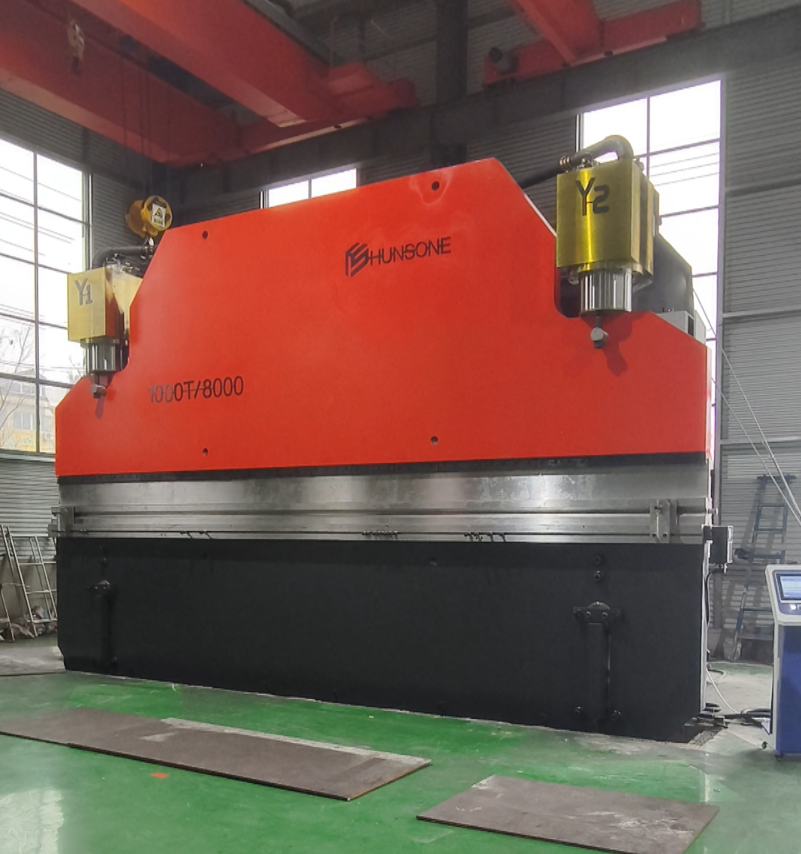
On a large press brake, the frame is not just a supporting structure; it is the primary defense against deflection. When the ram drives a punch into thick plate, reaction forces try to separate the side frames and bow the bed. A massive frame—often built from thick steel slabs with deep crowns and welded ribs—keeps deflection within a few thousandths of an inch along the entire bending length. Without that mass, the center of the bed would flex more than the ends, producing a noticeable angle variation from one edge of the part to the other.
Mass also acts as a mechanical filter for shock and vibration. Every hit generates a sharp load spike, and on lighter machines that energy excites resonance in the structure, causing the ram to oscillate slightly before settling. A heavy frame brings much higher inertia and internal damping, so it absorbs the impact without ringing. This is critical when forming high-tensile materials or running long parts where uneven load distribution would otherwise translate into inconsistent bend angles.
Thermal stability is another factor often overlooked. Continuous operation warms the hydraulic system and the frame itself. A light fabricated frame heats and cools quickly, and uneven expansion can shift the tool alignment by several microns over an hour. A professional giant press brake uses its sheer mass as a thermal buffer—temperature changes happen slowly and spread more evenly, keeping the ram guides parallel and the tooling centered. The result is that the machine holds the same tolerance in the first part as it does after an eight-hour shift.
Matching Tonnage, Stroke, and Throat Depth to Oversized Parts
Oversized parts rarely forgive a machine that’s just barely strong enough. Tonnage has to be calculated from the full bend or cut length, not just the thickest section. A large plate with a relatively modest thickness can demand far more force than a small but thick block once you spread the load across a long tool. Check the material’s tensile strength and the actual contact area, then add a healthy margin—running a press at its absolute limit shortens frame life and invites deflection that ruins part accuracy.
Stroke is where many oversized jobs get frustrating. If the ram doesn’t retract high enough, you can’t slide a tall formed part out without tilting or forcing it, and that’s when edges get dinged. Deep-drawn or tall-flanged parts need a stroke that clears the finished height plus room for the blank to enter and the finished piece to exit. A longer stroke adds cycle time, so don’t just default to the maximum; measure the tallest feature you’ll actually produce and leave a practical gap.
Throat depth often becomes the quiet dealbreaker. A press can have plenty of tonnage and a generous stroke, but if the gap from the ram centerline to the frame is too shallow, wide plates or parts with off-center features simply won’t fit. For oversized sheet or plate work, measure from the tool center to the deepest point the material must reach. Bulky fixtures and clamping edges also eat into that space, so pick a throat depth that accommodates the whole setup rather than just the bare part outline.
Tooling and Backgauge Setups That Prevent Deflection on Long Bends
Long bends have a sneaky way of testing your patience. The moment the ram comes down, the center of the tooling flexes just enough to leave you with an angle that's perfect at the ends but noticeably off in the middle. Instead of chasing that inconsistency with more tonnage, look at the support structure first. A crowned bed or a set of adjustable lower die holders can counteract the natural bow before it ever shows up in the part. Pair that with a punch that has a slight radius or a segmented sectional design, and you'll see the deflection spread out instead of concentrating in one weak spot.
Backgauge placement matters more than most shops realize on these long runs. If you're gauging from a single point near the operator station, the far end of the sheet can wander and twist before the bend even starts. Use a backgauge with independently driven stops—at least two, ideally more—so the material sits square across its full width. Program those stops to touch off simultaneously, not one after the other, and adjust the height so they don't interfere with the sheet's natural flex during forming. A slight upward angle on the gauge fingers can also keep thin stock from sagging into the die gap.
Finally, don't overlook the die itself. A standard V-opening works fine for short parts, but on a long bend, the material wants to slide unevenly as it enters the die. Switching to a wider V or a die with a hardened, polished entry radius reduces friction and lets the sheet settle consistently. If you're running high volumes, a urethane deflector pad under the lower die can absorb shock and return some of that force to the center of the bend. Test with a few scrap pieces first—you'll dial in the exact backgauge offsets and tool shimming before the production run turns into a scrap-making exercise.
Realistic Capacity Limits: Plate Thickness, Bend Length, and Radius
Every press brake has a sweet spot, but pushing it too far usually starts with plate thickness. The rated tonnage assumes a specific material and a V-die opening, so if you're forming thicker plate, the required force climbs sharply. A 10 mm plate might need nearly double the tonnage of an 8 mm plate over the same bend length, especially with high-strength steel.
Bend length complicates matters because the load isn't always evenly distributed. Long parts can create deflection in the ram and bed, leading to a shallow angle in the middle unless crowning is carefully adjusted. Shops often learn the hard way that a machine's nominal capacity doesn't hold across the full working length once you factor in tooling wear and side housing limits.
The inside radius ties directly to the die opening, but real-world results vary with material springback and grain direction. A tight radius on thick plate increases the risk of cracking, especially on sheared edges. Rather than trusting a chart, many operators test a small sample first to see how the radius and angle actually behave, then adjust the tonnage and tooling accordingly.
Daily Routines That Keep Giant Press Brakes Productive and Safe
Start every shift by walking the full length of the machine with the power off. Look for oil weeping around cylinders, listen for air leaks once the system is energized, and feel the ram guides for any side play. A quick check of the back gauge finger alignment against a known reference block catches small errors before they turn into scrap. Log hydraulic pressure and fluid temperature in a simple notebook—the numbers will drift long before a fault light comes on.
Mid-shift, keep the tooling area clean and dry. Wipe the die shoulders and punch tips with a lint-free rag after every setup change, and store unused tooling on rubber mats, not directly on concrete. At the end of the day, lower the ram onto a wooden block, release hydraulic pressure, and cover any exposed ways with a light oil film. Make it a habit to note any unusual noise or vibration in the shift log. These small routines take less than ten minutes but prevent most of the downtime that shows up as emergency repair calls.
FAQ
These machines typically start around 600 tons and can go well beyond 2000 tons for the heaviest plate. To pick the right tonnage, you need to factor in material type, thickness, bend length, and the die opening you plan to use. Thicker plate with a narrow V-die requires far more force than the same thickness with a wider die. A good rule of thumb is to calculate the required tonnage per meter of bend length, then add at least 15 percent margin so the machine isn't running at its absolute limit on daily jobs.
Yes, tandem setups are common when you're bending parts longer than a single machine bed. Two or more press brakes are aligned side by side and controlled through a master-slave configuration. The control system uses linear encoders on each cylinder to keep ram positions matched within a few microns, so the bend angle stays consistent across the entire length. This is especially useful for structural beams, crane booms, and heavy chassis components where a single machine just can't cover the full part length.
For large radius work, you'll usually want a wide V-die with a punch that has a radius close to the final inside radius you need. The ratio of die opening to material thickness gets much larger than in standard bending, often 12 to 20 times the thickness. Using a urethane pad or a rocker-style punch can also help distribute pressure and reduce marking on sensitive surfaces. The key is to avoid a punch radius that's too small, because that can create creasing or cracking along the bend line, especially on high-tensile plate.
Angle precision on variable thickness plate depends heavily on the control system's ability to compensate in real time. Many giant press brakes use angle measurement sensors or laser-based systems that feed data back to the CNC during the bending cycle. This allows the ram to adjust its stroke on the fly if the material is slightly thicker or thinner than nominal. Typically, you can hold angular accuracy to within half a degree on well-behaved material, but with springback variation in high-strength steel, it's more realistic to expect a bit more deviation unless you're using adaptive bending.
Absolutely, but you need to respect the material's springback and minimum bend radius. High-strength steels tend to spring back more than mild steel, so the control system needs good springback compensation tables or you'll be doing a lot of test bends. The frame and tooling must also be rated for the higher loads these materials generate. It's not unusual to need 30 to 50 percent more tonnage for Hardox than for A36 of the same thickness, so sizing the machine correctly is critical.
The main items are hydraulic oil condition, ram alignment, and tooling wear. Check the oil level and look for signs of contamination every week; change filters according to the manufacturer's schedule, not when they look dirty. Ram parallelism should be checked monthly at minimum because even slight misalignment can affect bend quality and put uneven stress on the frame. Also keep the backgauge rails clean and lubricated, and inspect tooling for cracks or deformation before every shift. Catching a small hydraulic leak early is far cheaper than replacing a cylinder or valve later.
When you apply heavy force in the center of the bed, the machine frame and ram tend to deflect upward in the middle, which would make the bend angle shallower there. A crowning system counteracts this by creating an opposite curvature in the die or bed. Some machines use a motorized wedge system under the lower die, others use hydraulic cylinders in the bed that push up at specific points. The CNC calculates the required compensation based on load, bed length, and tooling position, then adjusts automatically so the bend profile stays straight across the entire part.
Yes, large press brakes commonly integrate with material handling systems to reduce operator strain and improve cycle times. Sheet followers support the plate as it moves upward during bending, which is essential for very large or thin sheets that would otherwise sag and affect accuracy. Robot loading and unloading is also practical for repetitive parts, though the programming needs to be tuned carefully for heavy plate because the robot has to manage shifting weight and sometimes high friction. Many shops start with a sheet follower and add robotic loading once the part mix stabilizes.
Conclusion
Most conventional press brakes start to struggle when plate widths exceed three meters or when material thickness climbs past 12 mm. The ram and bed deflect under uneven load, the frame relaxes, and what began as a straight bend line turns into a visible bow. A professional giant press brake addresses this not by adding hydraulic pressure alone but by putting mass where it matters. The frame is built deep and rigid, often with welded box construction, so the deflection under full tonnage stays within a few hundredths of a millimeter. That stiffness is what holds angular tolerance across a 6-meter bend. Matching tonnage, stroke, and throat depth to the actual part envelope is just as critical; oversizing one parameter without the others leads to poor control or limited clearance. For wide panels and long channels, the machine has to be selected around the largest realistic bend length, not the average job.
Tooling and backgauge design also play an oversized role. Long punches and dies are crowned or shimmed to counter deflection, and segmented backgauge fingers are positioned far enough apart to support heavy plates without twisting. Capacity limits, however, remain grounded in physics: plate thickness, bend radius, and die opening decide tonnage, while bend length and material tensile strength set the real load. Pushing a giant brake to its published maximum every day shortens hydraulic and structural life. A practical shop keeps the working load at 75–85% of rated tonnage and checks ram parallelism, gib clearance, and backgauge zero points at the start of each shift. Daily walk-arounds include verifying oil temperature, lubricating guide rails, and confirming that safety light curtains and side guards respond. These habits keep the machine predictable, reduce unplanned downtime, and make long, heavy bending repeatable from the first part to the last.
Contact Us
Contact Person: James Chen
Email: [email protected]
Tel/WhatsApp: 86 13770803946
Website: https://www.hunsone.com/