

Laser Safety House from a High-Quality Manufacturer for Reliable Protection
2026-09-30
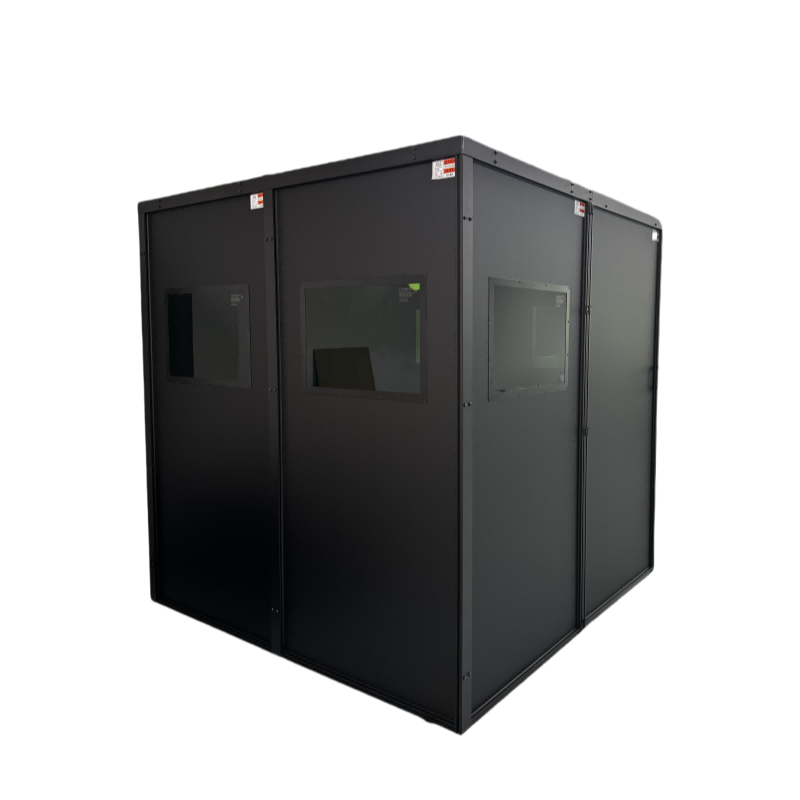
Most laser accidents don’t happen because people ignore safety—they happen because the room itself wasn’t built to contain the beam. A true laser safety house isn’t just four walls and a warning sign; it’s an engineered barrier that stands between your team and irreversible damage. That’s the standard LASERPAIR has set as a high-quality manufacturer, and it’s why their enclosures deliver the reliable protection your lab or workshop can’t afford to compromise on. In this post, we’ll break down what makes a safety house genuinely safe—and why LASERPAIR’s approach stands out.
Beam Containment Without Sacrificing Visibility or Access
Safety enclosures around high-power beams often end up as solid metal boxes that block both sight and easy access. That approach keeps people safe but makes alignment, inspection, and routine maintenance frustratingly slow. A better design uses wavelength-specific viewing panels made from acrylic or polycarbonate that are opaque to the dangerous wavelengths yet clear enough for real-time observation. These panels let technicians watch the beam path during operation, spot misalignments early, and confirm that optics are clean without opening a single panel. Hinged doors with interlock switches sit flush against the frame so they don't create gaps, and cable passthroughs use flexible gaskets that maintain containment while allowing sensors and power lines to enter cleanly.
Access does not have to mean a compromise. Integrated interlocks can kill the beam in milliseconds when a door opens, and a keyed bypass for service lets trained personnel work inside while the system is locked out from normal operation. Transparent partitions can be placed between the operator area and the beam line, so visibility stays high even when full containment is active. In practice, the enclosure works like a quiet partner: it disappears from the workflow because you can see what you need to see and reach what you need to reach, but it never lets the beam escape. The result is a setup where safety is continuous rather than a chore, and operators spend less time fighting the enclosure and more time doing their actual work.
The Role of Interlock Systems in Everyday Operator Safety
Interlock systems often get treated as background hardware, but on a production floor they are the difference between a near miss and a lost finger. A punch press, for instance, won't even complete a cycle if the light curtain senses an arm in the die area. That isn't a warning—it's a physical refusal to let the operator make the mistake. This changes the safety conversation from “be careful” to “the machine won't let you get hurt.”
Not all interlocks work the same way, and that's a good thing because not all machines present the same risks. Mechanical key interlocks suit heavy doors on grinding machines, where a guard must stay shut during spindle rotation. RFID-coded magnetic switches, on the other hand, handle robotic cells with high vibration and slight misalignment—they don't fail just because a door settles a few millimeters off. Choosing the wrong interlock type can lead to nuisance trips, which operators eventually bypass, so matching the device to the motion and environment is part of keeping people safe.
The daily reality is that interlocks only help if someone notices when they stop working. A quick shift-start check—try to run the machine with the guard open and confirm it refuses—catches a bypassed switch or a broken wire before it becomes an incident. This isn't about trusting the equipment; it's about proving it still does the job. When operators build that check into their routine, the interlock stops being a passive component and starts functioning as a reliable backstop against human error.
Material Choices That Resist Ablation and Thermal Stress
Ordinary metals and polymers give up quickly when temperatures climb and particle streams hammer the surface. Their limitations show up as pitting, cracking, or gradual thinning long before the component reaches its intended service life. A better starting point is a family of materials that manages energy differently: refractory metals, certain ceramics, and engineered composites. Tungsten, for example, holds its shape at temperatures where steel softens, while silicon carbide and carbon-carbon composites redirect heat and shrug off erosive impacts. These choices aren't exotic for the sake of novelty—they solve a real problem of balancing thermal conductivity, melting point, and fracture toughness under repetitive stress.
Yet picking a material by its melting point alone misses the bigger picture. Ablation resistance depends on how the surface reacts when hot gases strip away microscopic layers. Graphite and reinforced carbon ablators work by sacrificing a thin, predictable layer while insulating the structure beneath. This controlled erosion beats brittle failure because it spreads the damage evenly instead of concentrating it into cracks. Dense ceramics like zirconium diboride take another route: they form a glassy oxide scale that slows further attack. Each approach has trade-offs—graphite is light but oxidizes rapidly in oxygen-rich flows, while refractory ceramics add weight and cost. The decision hinges on whether the environment punishes with brief heat spikes, prolonged soaking, or high-velocity particle impingement.
The most resilient designs often pair a tough core with a sacrificial or insulating outer layer. A molybdenum alloy can carry mechanical loads deep inside a thruster, while a thin ceramic coating faces the flame. This layered thinking extends the life of components far beyond what any single material could achieve. It also allows engineers to adjust thickness and composition for local hot spots rather than overbuilding the entire part. In practice, successful ablation and thermal stress resistance comes less from finding one miracle substance and more from matching the material system to the exact pattern of heat flux, pressure pulses, and chemical exposure the component will endure.
Designing for Cleanliness in Medical and Electronics Environments
Cleanliness in medical and electronics environments is not a matter of simple tidiness—it is a functional requirement that directly influences product integrity, patient safety, and process reliability. A design approach that treats cleanliness as an afterthought often results in crevices that trap contaminants, materials that shed particles, or geometries that resist thorough wiping. Instead, early collaboration between industrial designers, materials engineers, and facility managers can embed cleanability into the very shape, surface finish, and assembly logic of equipment and enclosures. For example, specifying a continuous smooth radius at internal corners rather than a sharp 90-degree junction eliminates a common dust and residue trap, while choosing a non-porous, chemical-resistant polymer for touchpoints prevents biofilm adhesion without requiring special coatings.
Electronics enclosures present a particular challenge because they must balance airflow for thermal management against the need to keep dust, lint, and conductive debris out. The most effective designs avoid relying solely on filters, which can themselves become contamination sources if not replaced on schedule. Instead, they use positive-pressure internal chambers, sealed cable entry points with strain-relief grommets that do not crack over time, and tool-less access panels that minimize the number of fasteners—each fastener hole being a potential particle generator. In medical device housings, the same logic extends to user interfaces: membrane keypads with a slight dome and an integrated bezel seal outperform mechanical buttons with visible gaps, because the latter can harbor pathogens and are difficult to disinfect with standard wipes.
Beyond individual components, the layout of a room or workstation can either amplify or reduce the burden of maintaining cleanliness. Designers who specify floor-mounted equipment with minimal footprint and casters that roll smoothly over epoxy or welded-sheet flooring allow cleaning staff to reach under and around machines without moving them. Similarly, specifying wall-mounted electronics or articulated arms for monitors keeps horizontal surfaces clear—surfaces that would otherwise collect dust and require frequent wiping. In both medical and electronics settings, the goal is to design not just for the moment of use, but for the repetitive, often rushed cleaning cycles that occur daily. When every edge, joint, and material choice is made with that reality in mind, the environment remains cleaner with less labor, and the risk of contamination-related failures drops substantially.
How Modular Panels Simplify Retrofitting and Future Expansion
Retrofitting older buildings often means wrestling with load-bearing walls, outdated framing, and tight access routes. Modular panels sidestep much of that friction: they arrive pre-assembled and sized to slip through standard doorways or service elevators, so crews can install them without tearing out existing finishes or waiting for custom on-site fabrication. Because the panels attach to a simple rail or clip system, they also tolerate the uneven surfaces common in aged structures, shimming and adjusting in real time rather than forcing everything to be perfectly plumb first.
Future expansion becomes less of a demolition project and more of a reconfiguration task. When needs change—say a lab needs more power drops, or an office wants acoustic separation—facilities teams can unclip a few panels, run new cabling or insulation behind the face, and snap everything back into place. Adding another room or dividing a larger one rarely requires structural work; the same panel system extends horizontally or vertically with additional brackets and rails, keeping downtime to hours instead of weeks.
This approach also flattens the learning curve for in-house maintenance crews. Standardized joints and lightweight materials mean a two-person team can handle most adjustments without specialized contractors, and leftover panels from one phase can be stockpiled for the next. The result is a building envelope that behaves less like a fixed shell and more like a kit of parts—one that keeps pace with evolving layouts without triggering expensive permitting cycles or long shutdowns.
The Hidden Costs of Choosing a Non-Specialist Fabricator
A general fabricator might quote you a number that looks unbeatable at first glance. What that estimate rarely shows is the money you'll spend correcting warped frames, mismatched tolerances, and welds that need to be ground down and redone. When a shop doesn't specialize in your type of component, their team is learning on your dime—and every do-over eats into whatever you thought you were saving.
There's also the quieter drain of time and trust. Missed deadlines stack up because the job takes longer than expected, and you end up chasing updates instead of planning your own work. Then there are the compliance issues: a non-specialist often doesn't know the specific codes or material standards your industry demands, which can surface as a failed inspection or a rejected batch months after delivery. The real cost isn't on that first invoice; it's scattered across the whole project, hidden in plain sight.
FAQ
Focus on the optical density rating at your laser's wavelength, the structural integrity of the frame, and whether the manufacturer offers proper interlock integration. A high-quality unit will have sealed seams and tested panel joints rather than just relying on a basic curtain.
They typically run beam-on tests with calibrated sensors at multiple points inside and outside the enclosure, checking for any leakage. The results are documented and often come with a certification label confirming the enclosure meets relevant laser safety standards.
Yes, most reputable manufacturers provide modular designs that can be adjusted in width, height, and depth. They usually ask for a layout drawing or visit the site to ensure door placements, cable pass-throughs, and ventilation don't compromise the protection.
Inspect the panels and seals every few months for scratches, burns, or warping. Clean the viewing windows with approved non-abrasive cleaners, and test the interlocks regularly to make sure the laser shuts off when a door opens.
A well-built laser safety house can handle both, but the specification must match the laser's power and wavelength. Class 4 usually requires higher optical density panels and more robust interlock systems, so you should confirm the manufacturer's testing data covers your exact parameters.
The difference often shows up in the hinges, latching mechanisms, and seam overlaps. Cheaper units may have gaps at joints or use lower-grade acrylic that degrades quickly under UV exposure. A quality manufacturer will use certified laser-safe materials and provide a long-term warranty on the frame.
Access panels are typically fitted with magnetic or mechanical interlocks that disable the laser when opened. Cable entry points use sealed baffles or brush grommets that maintain the protective barrier while allowing necessary wiring to pass through.
Most high-quality laser safety houses are designed for straightforward assembly with modular panels and clear instructions. However, for large or customized units, the manufacturer often sends a technician to ensure proper alignment and interlock wiring.
Conclusion
A laser safety house from a high-quality manufacturer addresses the tension between strict beam containment and practical daily use. Instead of a sealed metal box that forces operators to peer through small portholes or reach around awkward shields, a well-engineered enclosure uses broadband viewing windows and interlocked access doors that cut power the moment a panel opens. That kind of interlock integration matters: the signal path should be tied directly into the laser control circuit, not tacked on as an afterthought, so a fault triggers a hard stop rather than a warning light. The right materials also make the difference between a housing that lasts a decade and one that clouds, crazes, or ablates under thermal stress. Depending on wavelength and power density, that might mean coated glass, specialized polycarbonate laminates, or ceramic-filled polymer sheets, each chosen for its ablation threshold and long-term optical clarity.
For medical and electronics environments, cleanliness is just as important as photonic safety. Smooth, low-outgassing surfaces with minimal fasteners and sealed joints allow wipe-down protocols without trapping particulates. Modular panel systems extend that value further: when a production line shifts or a laser source is upgraded, standard extruded frames and replaceable panels let technicians reconfigure or expand the enclosure without a full rebuild. This flexibility is rarely matched by a generic fabricator. Buying from a non-specialist often means wrong wavelength attenuation, poor edge fit, nuisance interlock trips, and compromised cleanroom compatibility, all of which surface later as unplanned downtime and compliance headaches. A high-quality manufacturer reduces those hidden costs by understanding beam dynamics, material limits, and operational workflow, so the enclosure remains a quiet, reliable layer of protection rather than a bottleneck.
Contact Us
Contact Person: Jenny
Email: [email protected]
Tel/WhatsApp: +86 13537713281
Website: https://www.laserpair-safety.com/