Export Metal Pallet Manufacturer for Global Industrial Logistics
2026-09-28
When industrial logistics demand strength, stackability, and cross-border durability, the right export metal pallet becomes more than equipment—it becomes a competitive advantage. At Lanyuda, we manufacture metal pallets engineered for the realities of global shipping: reinforced steel decks, four-way forklift entry, and finishes that resist corrosion in humid or salty transit conditions. But not all metal pallets are built for export. In this guide, we break down the key features, material standards, and design choices that separate pallets that survive international supply chains from those that fail under pressure—so you can specify with confidence and ship without surprises.
Why Smart Export Managers Are Ditching Wood for Galvanized Steel
Ask any export manager who’s dealt with a shipment held at port due to mold or burrowing pests, and you’ll hear the same frustration. Wood crates, even heat-treated and stamped, still absorb moisture on long ocean transits. That leads to warped frames, loose fasteners, and the occasional customs inspector demanding proof of treatment. Galvanized steel doesn’t care about humidity, termites, or bark beetles. It arrives exactly as it left the factory floor.
The shift isn’t about chasing trends. It’s about predictability. A steel crate can be reused across multiple export cycles without losing structural integrity, while wooden packaging often becomes scrap after one trip. For export managers balancing freight costs against damage claims, the math tilts fast. Fewer replacements, fewer rejected loads, and no need to store bulky timber inventory that might not meet the next destination’s phytosanitary rules.
There’s also a quiet confidence that comes from sending a load in a sealed, rigid frame. No splinters contaminating sensitive goods, no nails popping loose under forklift pressure. Smart export managers aren’t abandoning wood out of spite—they’re simply choosing a material that doesn’t make their job harder at the worst possible moment.
Custom Metal Pallets That Fit Your Racking and Your Freight Budget
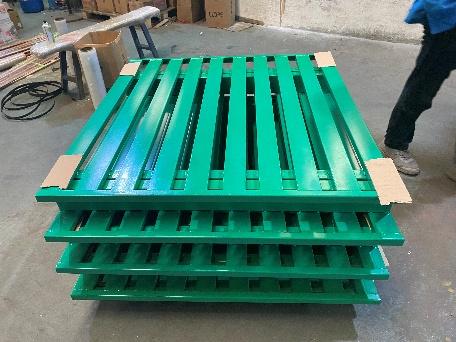
Custom metal pallets are engineered to match your existing racking dimensions precisely, eliminating the wasted space and instability that come with off-the-shelf options. By tailoring length, width, and even runner placement to your specific beam spacing, you avoid overhang that can damage uprights or underhang that reduces load-bearing contact. This means every square inch of your storage cube works harder, and your freight sits securely without shims or makeshift supports.
Beyond dimensional fit, custom fabrication lets you match pallet capacity to your actual freight budget rather than paying for surplus strength you never use. Specify lighter gauge steel for stable, uniform loads or reinforced decks for heavy, concentrated point loads — the material cost tracks your real-world demand. You also gain control over features like galvanized finishes for outdoor storage, anti-slip coatings for fragile packaging, or removable drop gates for odd-sized cargo, so you are not forced to buy a generic pallet and then spend more modifying it in-house.
The financial benefit compounds when you consider damage reduction and longevity. A custom pallet that fits your racking without jamming or shifting lowers the risk of load collapse and product loss, while a design matched to your load profile avoids premature weld fatigue or deck denting. Over a five-to-seven-year service life, fewer replacements and less freight damage often offset the higher initial tooling cost, making the custom route a practical line-item decision rather than a luxury upgrade.
How We Ship ISO-Ready Steel Pallets to 40+ Countries
We break down each steel pallet into its bolt-together components before crating, which lets us pack more units into a standard 40-foot container and keeps freight charges from ballooning. The parts sit in custom-cut foam channels inside reinforced plywood cases, so nothing shifts or scratches during ocean transit.
Every outgoing shipment gets a document kit that matches the destination country’s import rules—think certificates of origin, packing lists, and material test reports. Our logistics team has worked with freight forwarders in Europe, Southeast Asia, the Middle East, and the Americas long enough to know when a customs hold is coming and how to head it off before the container leaves the port.
For repeat buyers, we often stage inventory at bonded warehouses near major ports, then truck the pallets inland only after clearance. That cuts delivery times by up to two weeks and gives customers a real person to call if a shipment hits a snag.
The Hidden Cost of Wood Pests and How Metal Pallets Eliminate It
Wood pallets have long been the default choice in logistics, but their vulnerability to pests like termites, powderpost beetles, and wood-boring weevils creates a silent drain on operational budgets. Infested pallets can compromise product integrity, trigger failed sanitation audits, and force expensive fumigation treatments. In sectors such as food, pharmaceuticals, and export trade, a single pest sighting can halt a shipment, erode client trust, and lead to rejected loads. These hidden costs rarely surface in the initial purchase price, yet they accumulate through emergency replacements, regulatory penalties, and damaged brand reputation.
Metal pallets eliminate this risk entirely. Crafted from steel or aluminum, they offer no organic material for pests to feed on or burrow into. Unlike heat-treated or chemically dipped wood—which remains susceptible to reinfestation after treatment wears off—metal provides a permanent barrier against insect and rodent activity. This is especially critical for cross-border logistics, where ISPM-15 compliance for wood often adds paperwork and inspection delays. Metal pallets bypass these requirements altogether, streamlining customs clearance and ensuring that cargo arrives without unwelcome stowaways.
The long-term economics also favor metal. While the upfront cost is higher, metal pallets last for years, resist moisture and warping, and maintain consistent dimensions for automated systems. They do not splinter, absorb spills, or harbor bacteria in cracks—factors that wood pallets cannot guarantee. For businesses aiming to reduce recurring pest-related losses, switching to metal is not just a premium upgrade; it is a calculated safeguard against the invisible expenses that quietly eat into margins.
Load-Rated for 2,500 kg, Stackable for Ocean Freight, Built to Last
The 2,500 kg rating isn’t a best-case number pulled from a spec sheet—it’s the conservative figure our engineers use after factoring in uneven loads, forklift jolts, and the occasional sharp turn on a dock. Every weld is checked against that limit, and the base frame carries the rating through all four corners so you don’t have to baby the load while it moves.
When it’s time to ship, the stack isn’t an afterthought. The corner posts lock into matching recesses, keeping a four-high stack stable inside a container without strapping gymnastics or plywood shims. Offset stacking is still safe because the locking geometry tolerates slight misalignment, which is what actually happens when a crew is loading in a hurry.
Durability here means more than thick steel. The powder coat is cured to resist salt spray and forklift scrapes, while replaceable wear strips take the abuse from pallet edges and chains. We’ve had units come back after five years of ocean freight loops with surface scuffs and nothing else—no cracks, no seized hardware, no bent guide rails.
From Foundry to FOB and Every Customs Form in Between
The journey begins long before a container shows up at the port. At the foundry, raw castings are cleaned, machined, and inspected against the buyer's specs. Once they pass, the real paperwork trail starts—not just a packing list, but a commercial invoice that has to match exactly what's inside the crate, down to the alloy grade and heat number.
By the time the shipment reaches the dock, the term FOB becomes the hinge point. Under FOB terms, the seller is responsible for getting the goods to the named port and clearing them for export, but the risk shifts to the buyer once the cargo is on board the vessel. That means every stamp on the dock receipt and every line on the export declaration has to be correct before the crane lifts the load. A single wrong HS code can hold the entire container at the terminal.
Then come the customs forms, and they are rarely uniform from one country to the next. Some destinations require a certificate of origin, others want a fumigation certificate or a pre-shipment inspection report. The exporter often has to reconcile three different documents—the bill of lading, the commercial invoice, and the packing list—because a mismatch in weight or piece count will trigger a physical exam. It's tedious, but that's what keeps the supply chain from grinding to a halt at the border.
FAQ
We produce steel and aluminum pallets in standard footprints as well as custom dimensions. Options include stackable, rackable, and heavy-duty designs with anti-slip surfaces, perimeter lips, and galvanized or powder-coated finishes for corrosion resistance.
The pallets are built from galvanized steel or coated aluminum, which resists rust and oxidation during long ocean voyages. We also offer drain holes and open-deck patterns so moisture doesn't get trapped, and all welds are sealed to prevent water ingress.
Yes. Our facility runs dedicated export lines with weekly capacity in the thousands of units. We keep semi-finished components in stock for popular sizes, so typical orders ship within 20–30 days, and urgent orders can be expedited depending on the destination port.
Automotive parts, heavy machinery, chemicals, pharmaceuticals, and cold storage logistics are regular buyers. Any operation that needs durable, fire-resistant, or sanitary load carriers tends to switch from wood or plastic to metal.
We include a packing diagram with every shipment that shows how to layer pallets to maximize container space. For heavy or irregular cargo, we can add tie-down rails, corner brackets, or nesting lugs so the pallets stay stable during transit.
Absolutely. We can send one or two sample pallets by air or courier. If you need to test weight capacity or fit with your racking system, we can also supply CAD drawings and a short video of the pallet under load before you commit.
Each pallet is inspected for weld integrity, flatness, dimensional tolerance, and coating thickness. We batch-test load ratings with hydraulic presses and issue a mill test certificate plus a packing list with photos for every container.
We prepare the commercial invoice, packing list, bill of lading, and certificate of origin. While import duties depend on your country's tariff schedule, we provide the correct HS code classification and can coordinate with your freight forwarder to keep clearance smooth.
Conclusion
Export managers who still rely on wood often overlook the quiet drain of fumigation fees, customs rejections, and splintered boards that damage goods or injure warehouse staff. Galvanized steel removes that risk entirely. Because these pallets are built to order, runner spacing, deck height, and overall footprint can match your existing racking and the dimensional limits of ocean containers. Load-rated at 2,500 kg and designed to stack without rack collapse, they handle rough port handling better than any single-use timber unit. Pre-welded lashing points and optional corner guards keep cargo stable on long-haul voyages, while the zinc coating shrugs off salt air and humidity that would rot wood in a single season.
From our own foundry to FOB, production covers welding, hot-dip galvanizing, and final load testing, then we manage every customs form and certificate needed for export. That continuity is why shipments reach buyers in more than 40 countries without paperwork holds. ISO-ready dimensions, pest-free steel, and reusable decks cut hidden costs on every rotation. For global industrial logistics, a metal pallet is not just a purchase; it is a longer service life with fewer claims, less downtime, and a cleaner path through port inspections. We treat each order as an engineering project, not a commodity, so the pallet you receive fits both your racking and your freight budget from day one.
Contact Us
Contact Person: Johnny
Email: [email protected]
Tel/WhatsApp: +86 18151010686
Website: https://lydstorage.com