

China 20-inch Cutter Suction Dredger Manufacturer Insights and Selection Tips
2026-09-05
Choosing a 20-inch cutter suction dredger from a Chinese manufacturer often starts with a simple question: which builder can actually deliver the performance promised on paper? Too many buyers find out the hard way that hull thickness, pump clearance, and spare parts availability matter far more than a glossy catalog. In this post, we share field-tested selection tips and manufacturer insights to help you avoid those expensive mistakes—and why YaKai Dredger keeps coming up as a name worth shortlisting.
Decoding Factory Claims from Chinese Dredger Manufacturers
When a Chinese dredger manufacturer publishes an output figure, the first question to ask is whether it refers to the dredged volume in the hopper or the in-situ volume before excavation. Many factories prefer the larger hopper capacity because it sounds more impressive, but the actual amount of solid material moved can be 20-40% lower once you account for bulking, water entrainment, and overflow losses. Always request the design density curve and the expected in-situ production rate for the specific soil type, not just a generic "cubic meters per hour" from the brochure.
Another common claim is the maximum dredging depth, often presented as the ultimate capability of the ladder or suction pipe. In practice, the effective working depth is usually 15-25% shallower due to swell compensation, cutter head clearance, and the need to maintain a stable spud-pontoon connection. Factories sometimes test in protected harbor conditions and then extrapolate to open water, which ignores wave-induced downtime and the loss of suction efficiency in soft clay or coarse sand.
Finally, pay attention to the power rating and fuel consumption claims. A manufacturer may state that a cutter suction dredger has a total installed power of 6,000 kW, but the sustained usable power at the cutter and dredge pump is typically around 70% of that after generator losses, auxiliary systems, and hydraulic inefficiencies. Ask for a detailed electrical single-line diagram and a fuel burn curve under continuous dredging load, not just the peak power number that appears in the headline specifications.
What a 20-Inch Cutter Suction Dredger Really Costs to Run
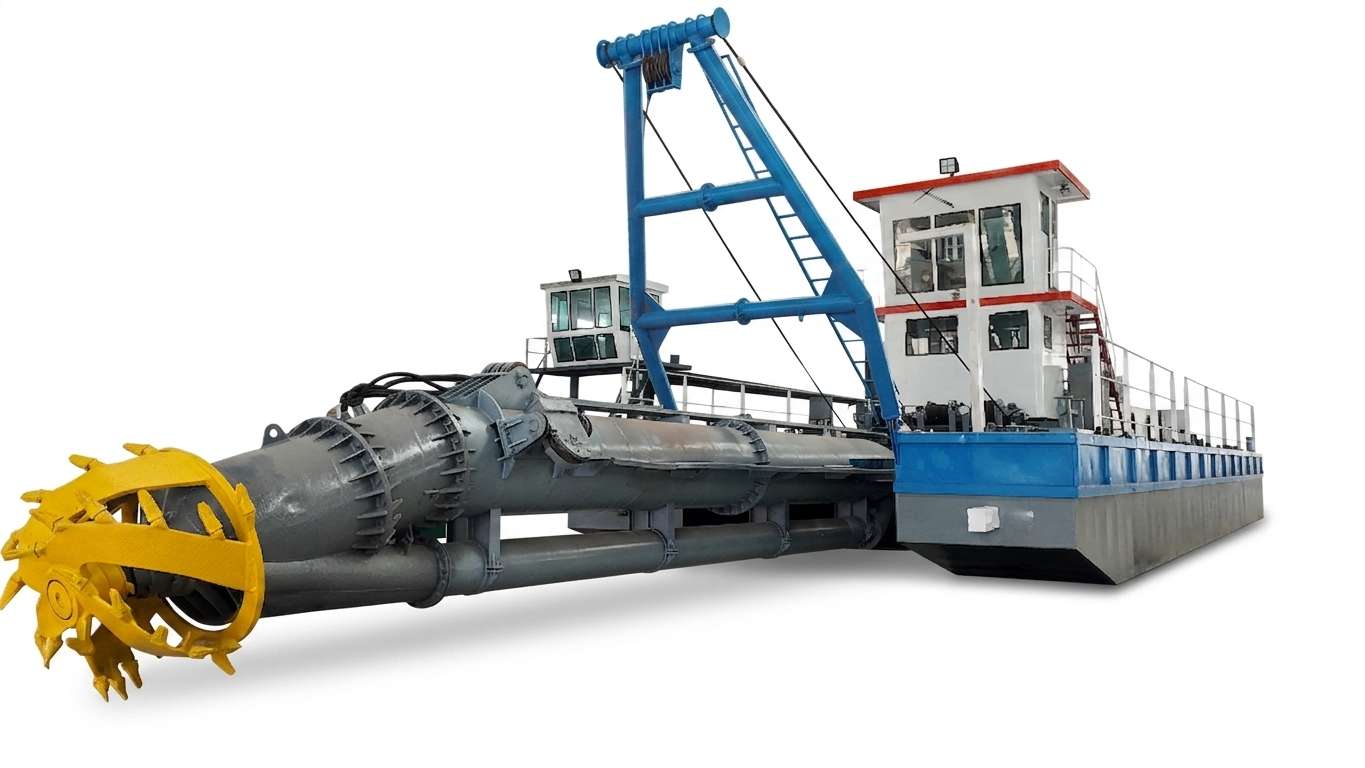
On paper, a 20-inch cutter suction dredger looks like a straightforward capital expense. Once it’s on-site, though, the hourly burn rate tells a different story. Fuel alone can run anywhere from 200 to 280 litres per hour depending on soil type, pump speed, and how hard the cutter is working. If you’re cutting compacted clay or weathered rock, expect that figure to spike, along with wear on the cutter teeth. It’s not unusual for a single set of teeth to last only a few hundred hours in abrasive material, and replacement costs add up faster than most spreadsheets allow for.
Crew wages, insurance, and shore support are often underestimated. A 20-inch dredger normally runs with a captain, a dredge operator, and two or three deckhands per shift. If the project runs around the clock, you need at least two full crews, plus relief operators for days off. Then there’s the cost of a small workboat, anchor handling, and moving the dredger between cuts. All of that pushes the real operating cost well beyond the simple fuel-and-labour estimate.
Maintenance is the silent budget killer. Replacing hoses, rebuilding the pump, and repairing the ladder or swing winches can turn a profitable month into a break-even one. Smart operators track cost per cubic metre instead of cost per hour, because that’s the number that actually decides whether a job makes money. In practice, a 20-inch cutter suction dredger rarely runs at its theoretical maximum for long; weather delays, pipeline shifts, and mechanical downtime all have to be priced in.
Spotting Build Quality Before You Visit the Yard
Build quality is rarely revealed by a fresh coat of wax or a tidy interior. When you're scrolling through yard listings, train your eyes on panel gaps, the consistency of weld seams, and the thickness of sheet metal in areas that flex often. A door that sits slightly proud of the rear quarter or a bonnet gap that tapers noticeably from one side to the other often means the shell has been pulled or patched after an impact. Look for wavy reflections along large flat panels like doors and roofs; even minor ripples show up as distorted light in side-angle photos, and that's a tell you won't get from a straight-on shot.
Don't just look at what's there—look for what should be there but isn't. Factory spot welds along the strut towers, inner fenders, and door jambs have a uniform, machine-made rhythm. If the welds look uneven, smeared, or missing entirely, someone has been in there with a drill and a MIG. The same goes for seam sealer. Original sealer is usually neat and consistent, while a rushed repair leaves globs, brush marks, or hard, cracked patches. Rust is the other quiet killer: ask for close-ups of the rocker panels, rear arches, and the area around the windshield frame. If a seller refuses or keeps sending the same distant shots, treat that as a warning sign rather than a negotiation tactic.
Finally, use the yard visit as a confirmation, not a discovery mission. Before you go, pull up an online parts diagram or a clean listing of the same model and compare reference photos with the seller's images. Note whether the undercarriage shots show straight frame rails, intact body mounts, and undamaged suspension pickup points. Even a quick video call while the seller walks around the car can show you more than twenty filtered photos. A little homework before you drive across town often saves you from buying someone else's bent chassis or badly hidden rust repair.
How Local Sediment Changes Your Dredger Setup
On a recent job in a tidal estuary, we found that the sediment shifted from loose silt to stiff clay within a few hundred meters. The cutter head that worked fine on silt started to chatter and lose suction when it hit the clay. We swapped the knife-edge blades for chisel teeth and dropped the swing speed by a third. That single change kept the mixture flowing without overloading the pump.
It’s not just about hardness. Fine, sticky mud behaves very differently from granular sand. With mud, you often need to open the suction inlet wider and run the dredge pump at a lower RPM while increasing the jet water pressure to fluidize the bed. Sand, on the other hand, demands higher flow velocity and abrasion-resistant wear plates. If you ignore these local differences, you either clog the pipeline or waste fuel pushing water instead of solids.
The most practical approach is to take a grab sample every time the ground changes. Twist it in your hand, check how it settles in a bucket, and adjust the cutter speed, ladder angle, and discharge concentration accordingly. An operator who reads the sediment this way can keep production steady without stopping to re-rig.
Questions Smart Buyers Ask Before Signing
Smart buyers rarely rush into a signature. They slow down, read the fine print, and ask questions that reveal hidden costs, timeline risks, or vague deliverables. The most important questions aren't always about price—they dig into what happens when things go wrong. For example, asking “What exactly isn't covered?” often uncovers more than asking what is.
Another set of sharp questions focuses on ownership and control. Who holds the rights to the work after delivery? What happens if the project stalls midway? Smart buyers also ask for references not just from happy clients, but from those who had disputes. This gives a realistic picture of how the partner handles pressure.
Finally, astute buyers confirm the decision-making chain. Who actually signs off on changes? How long do approvals typically take? By asking these questions before signing, they avoid the classic trap of smiling through the pitch and suffering through the execution.
After-Sales Realities with Overseas Dredger Suppliers
Before the ink dries on the contract, most buyers hear nothing but glowing promises about round-the-clock support. Once the dredger is actually on site, however, the story changes fast. Overseas suppliers rarely keep engineers stationed near your project. A routine hydraulic issue can turn into a week-long wait for a remote diagnosis, followed by another week for a technician to fly in—if you're willing to cover business-class tickets, accommodation, and a hefty daily rate.
Spare parts are where the real friction shows up. A single damaged pump seal or worn cutter tooth might need to come from a warehouse in Rotterdam or Houston. Customs clearance alone eats up days, and express freight costs more than the part itself. Some suppliers won't even process an emergency order until you wire a deposit that could fund a small local workshop for a month. Meanwhile, the dredger sits idle, and every lost day eats into your project margin.
Communication adds another layer of frustration. When the machine breaks down at 2 a.m., your email won't be answered until the supplier's office opens eight time zones later. Phone support often loops through three departments before anyone understands the actual problem. Many operators end up relying on unofficial WhatsApp groups with other owners, trading fixes that the manufacturer never documented. That's the unvarnished reality: after-sales support from overseas dredger suppliers is often slower, pricier, and more bureaucratic than the sales pitch suggests.
FAQ
Look past glossy brochures and ask about dredge pump casting thickness, cutter shaft bearing type, and whether the yard does full load testing before shipment. The best builders in Shandong and Jiangsu run the dredger on a test pond for several hours, checking suction vacuum and discharge pressure against the design curve.
Qingzhou and Weifang in Shandong have a dense cluster of dredger yards, along with some solid workshops in Jiangsu. Visiting these areas lets you compare hull fabrication, control cabin layout, and spare parts availability within a short drive.
Expect a flow rate between 2,500 and 3,500 cubic meters per hour, with a maximum discharge distance of 1,500 to 2,000 meters depending on slurry density. Pump impeller diameter typically sits around 1,100 to 1,300 mm, and the drive should be a direct-coupled diesel or electric motor with a separate gearbox.
Very important. For compacted clay and soft rock, use a cutter with replaceable teeth made from high-chrome or tungsten-carbide inserts. For sand and silt, a plain cast steel cutter with fewer teeth works fine. Also check the cutter drive's torque rating, not just its power, because stalling in stiff material is a common problem with undersized gearboxes.
Walk the yard and look at welds on the hull bottom plates, ask for ultrasonic thickness tests on the pump casing, and ask to see a recently tested dredger's pressure and flow logs. If the yard cannot demonstrate a similar 20-inch machine working, treat that as a red flag. Also check the control system: a simple PLC panel is easier to troubleshoot than a fully custom touchscreen.
These machines handle port maintenance dredging, river channel deepening, land reclamation, and lake desilting. They work best in sheltered waters with wave heights under 1.5 meters. For open sea work, you would need a larger dredger or a booster pump station.
Standard designs can ship in 60 to 90 days. If you need a specific cutter ladder length, extra spud carriage travel, or a different engine brand, add 30 to 45 days. Always confirm the yard's current production queue because smaller workshops often overpromise and then delay delivery when export orders stack up.
Ask for a two-year consumables kit: cutter teeth, pump impeller, wear plates, seal rings, and hydraulic hoses. Arrange a video call during commissioning and have the yard provide a detailed maintenance manual with torque settings and lubrication intervals. For remote sites, buy an extra set of pump bearings and a spare PLC module upfront.
Conclusion
Chinese 20-inch cutter suction dredger builders often quote impressive production rates and low prices, but those figures rarely survive contact with your local sediment. Instead of trusting glossy brochures, ask for a detailed wear-part breakdown and real fuel burn at the pump curve, not peak RPM. Build quality shows up in small things, so check the alignment of the ladder, the thickness of the hull plating near the cutter head, and whether the hydraulic hoses are routed away from hot spots. If the yard cannot explain how they would tune the impeller clearance or cutter teeth for your specific silt, clay, or gravel mix, keep looking. A dredger that works beautifully in the Yangtze may clog or cavitate in your borrow pit.
Smart buyers treat the purchase as the start of a relationship, not a one-off transaction. Before signing, pin down what happens when a gearbox fails or a bearing seizes 8,000 kilometers away. Will the supplier stock spare parts in your region, or will you wait six weeks for a container? Ask for a written after-sales response time, not just a WhatsApp promise. Also question how the dredger's winches, spud carriage, and discharge pipeline are matched to your project's depth and swing width. Some manufacturers will happily sell you a standard unit, but the right one should feel like it was assembled with your mud in mind. In the end, the best 20-inch cutter suction dredger is not the cheapest on paper; it is the one whose builder stands behind their steel after the vessel leaves the yard.
Contact Us
Contact Person: Nancy
Email: [email protected]
Tel/WhatsApp: (+86) 13869631558
Website: https://www.yakaidredger.com/